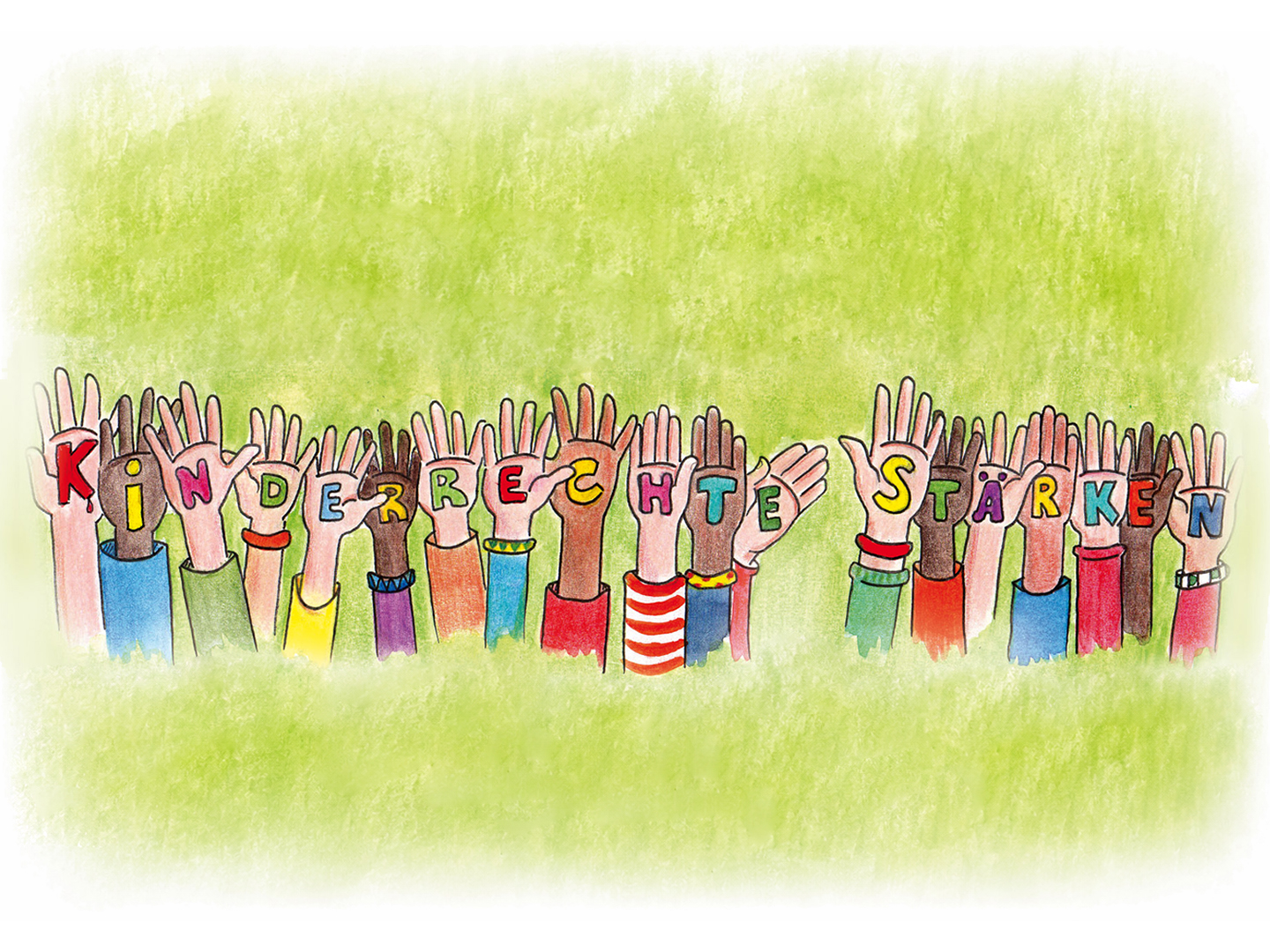
Bunte Hände heben sich in die Luft und bilden den Schriftzug "Kinderrechte stärken". Die Hände sind in verschiedenen Farben und Mustern gestaltet, vor einem sanften, grünen Hintergrund.

[Translate to Englisch:] Quelle: Aaron Jordan

Children's Rights

The dsj is committed to implementing and strengthening children's rights in sport and promotes participation, protection and development

Vorlesen
Ein cartoonartiger, gelber Leopard mit einem Stirnband und Sportkleidung hält ein Buch mit dem Titel "Kinderrechte" in seinen Händen. Er hat einen fröhlichen Gesichtsausdruck und steht aufrecht, während er auf das Buch zeigt.

Children have their own rights! That is what the United Nations Convention on the Rights of the Child states, and it applies to sports as well. For this reason, the German Sports Youth (dsj), together with its member organisations, is committed to ensuring that young people and the adults who work with them engage with children’s rights through physical activity, play, and sports. Rights to protection, support, and participation are equally important, and a collective effort is needed to ensure these rights are taken into account in the day-to-day work with children and youth in sports clubs.    

The dsj has been advocating for the implementation of children’s rights for many years. Among other initiatives, it published a policy framework on children’s rights in 1996, a calendar of events on children’s rights in 2017 and has been actively involved in the Alliance for the Right to Play for many years. Club sports should empower children and youth and provide a protective environment. That is why the dsj, the German Olympic Sports Confederation (DOSB) and their member organisations have developed the “Safe Sport” Future Plan, a comprehensive strategy to protect against violence in sports. In principle, children’s rights are incorporated into all areas of activity and initiatives of the dsj and its member organisations. To make this even more concrete and specific, the dsj is participating DOSB’s ongoing “Sports and Human Rights” initiative and provides resources in the form of materials and content that can be used, for example, by sports clubs.
 

Children's Rights Poster

What is the UN Convention on the Rights of the Child?

All children and adolescents have rights and deserve special protection, support, and care so that they can grow up healthy and freely develop their personalities. The Convention on the Rights of the Child, better known as the UN Convention on the Rights of the Child, is an international treaty that focuses on the rights of children under the age of 18. The UN Convention on the Rights of the Child was adopted by the United Nations on 20 November 1989, and entered into force on 2 September, 1990. It has since been ratified by nearly every country in the world—including Germany on 5 April, 1992. The signatory states recognise children as rights-holders and commit to promoting the realisation of children’s rights. Their actions are guided by the best interests of the child. It is thus one of the most important human rights instruments for children.  

Children’s rights are divided into:  

  1. Rights to Development: Include rights that promote the development of young people and provide them with the best possible opportunities for a healthy and happy future (e.g., the right to education). 
  2. Rights to Protection: Include rights that protect young people from various forms of violence and harm (e.g., the right to protection and care). 
  3. Participation rights: These rights state that young people have the right to be heard, to express their opinions, and to participate in decisions that affect them in a manner appropriate to their age and stage of development (e.g., the right to freedom of expression).

The four fundamental principles of the UN Convention on the Rights of the Child serve as the guiding framework for children’s rights.  

  1. Non-discrimination
  2. The right to life, survival, and development 
  3. Respect for the best interests of the child  
  4. The right to participation
Why Children’s Rights in Sports?

The German Sports Youth (dsj), as the largest independent provider of child and youth welfare services in Germany, is committed to promoting and safeguarding the rights of young people. This commitment is also enshrined in the human rights policy developed jointly by the DOSB and the dsj. This policy is based on the UN Guiding Principles on Business and Human Rights. Human rights apply to all people, including children and adolescents. In the context of sports, children’s rights are intended to ensure that sports are not only a place for athletic development but also a space where young people are respected, protected, and supported as individuals. To this end, the children’s rights outlined in the UN Convention on the Rights of the Child have been adapted specifically for the field of sports.

Das Bild zeigt ein stilisiertes Gebäude mit drei Säulen, die die Kinderrechte im Sport darstellen: Schutzrechte, Förderrechte und Beteiligungsrechte. Über dem Gebäude steht der Slogan "Kindeswohl steht über allem!" Auf den Säulen sind verschiedene Rechte aufgelistet, die Kinder im Sport betreffen.
Additional Resources and References